Training & workshops in washington state & worldwide
Training & Workshops
Trauma Informed & Culturally Humble Training

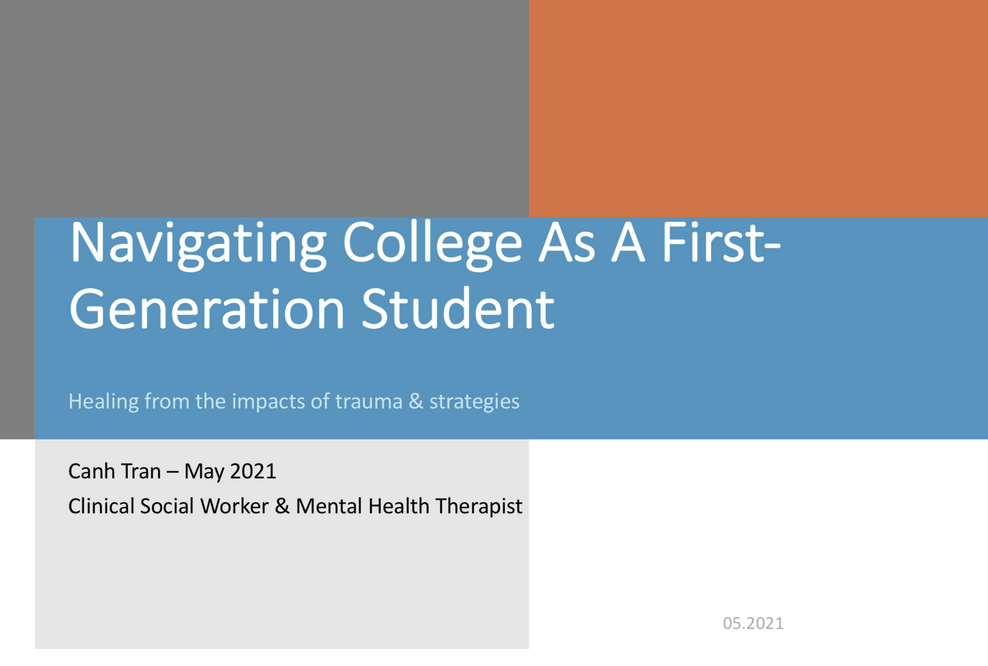
Mental Health Workshops
Offerings
Workshops
Presentations
These workshops weave in both professional, evidence based knowledge and skills, as well as my own stories.
I also invite participants to consider how their own stories have shaped them in how they make sense and navigate their relationships, work, and home.
My goal is for participants to have a better understanding of themselves, others, and ultimately so they can live with more authenticity and freedom at work, home, and in the world.
Topics I Speak About
For Corporations/Agencies
Trauma 101 (What is Trauma?)
Audience
This workshop is for those who seek to learn the basics of trauma and PTSD
Outcomes
Participants will be able to define what trauma and Post traumatic stress disorder (PTSD) is
Participants will learn the different types of trauma (complex, single incident, little t, big t, shock, intergenerational, historical, racial)
Participants will learn the causes, signs, and risk factors for trauma and PTSD
Participants will learn how trauma and PTSD affects health and mental health outcomes
Participants will learn how the brain is altered as a result of trauma
————————————————————————-
This presentation is more didactic and less experiential, meaning the focus of the workshop is on providing education and theoretical knowledge.
I include knowledge I’ve learned over 8 years of being a trauma therapist, in an easy to understand manner for non-clinicians.
Knowledge and education will be adapted based on your organization’s preferences and needs.
Sample practical knowledge I can offer include:
Framework shift from “What’s wrong with you?” to “What happened to you?” to “How did you get through this?”
Physical well being effects such as poorer health outcomes
Emotional well being effects such as emotional dsyregulation
Fight, Flight, Freeze, Fawn, Fright behavioral responses as an adaptation to trauma and survival
Trauma informed care AKA assume everyone may have a history of trauma, to prevent re-traumatization and create more safety
The trauma brain AKA amygdala
SAMHSA’s Six Guiding Principles
Safety
Trust & Transparency
Peer Support
Collaboration
Empowerment & Choice
Intersectional Identities
Organizational Self Care
Secondary and vicarious trauma
Boundaries to prevent burn out
Post traumatic growth
Compassion Fatigue, Vicarious & Secondary Trauma
Practical Individual Strategies & Skills For Management of Compassion Fatigue, Secondary & Vicarious Trauma
Audience
This workshop is for direct service providers/clinicians who work with a population that has experienced trauma, which brings up “stuff” that can feel overwhelming, messy and confusing.
Some participants may also have their own trauma history and experiences which will collude with their work and clients. This will also be addressed.
Outcomes
Participants will be able to define what compassion fatigue, secondary trauma, and vicarious trauma is
Participants will learn the causes, signs, and risk factors for compassion fatigue, vicarious and secondary trauma.
Participants will learn to how to increase their capacity and resilience for ongoing exposure to trauma
Participants will learn 3 somatic and experiential strategies to manage their symptoms of compassion fatigue, secondary trauma, and vicarious trauma
Participants will leave with a written plan that tracks what they need to do in order to intentionally take care of themselves in order to continue doing client facing work
————————————————————————-
Explore self-care techniques as well as strategies you can use to help ensure balance and self-care for those that you supervise or manage. Strategies can be adapted based on your organization’s preferences.
This presentation is less didactic and more experiential, meaning I focus more on practical therapeutic strategies so participants can experience healing in real time.
About 30-minutes for didactic lecture (e.g. defining terms) and 60-minutes for practical self reflection, small group share, and somatic and experiential skills/strategies.
Frameworks I incorporate include:
You and your trauma
Learning about trauma brings up our own trauma
This helps us learn some of the things our clients might be experiencing
It also gives us the opportunity to practice recognizing and containing our own trauma patterns and responses
What healing is ultimately about
Restoring capacity in the present moment (mindfulness)
Resilience & increased capacity to feel, think, and reflect vs. reacting in the moment
Healing from the impacts of compassion fatigue, secondary and vicarious trauma
Six levels (awareness, basic needs/support, emotional, physical, somatic, and ongoing practice)
Intentional self and community care
Boundaries (emotional, physical, and psychological)
Connections & social support
Strategies will be adapted based on your organization’s preferences.
Usually 3-4 strategies can be provided in a 90-minute workshop.
I include strategies I’ve learned over 8 years of being a trauma & grief therapist, in an easy to understand manner for non-clinicians. Sample practical therapeutic strategies I can offer include:
Skill #1: Interpersonal Neurobiology Skills. Click here to learn more.
Introduction to the Window of Tolerance
Understanding one’s Window of Tolerance
Creating/drawing one’s Window of Tolerance exercise
“Name it to tame it” and “feel it to heal it”
Skill #2: Types of Empathy & Boundary Setting Practices
The dangers of over empathizing
How to avoid over empathizing or merging with clients
Practices toward being empathic without merging
Skill #3: Mindful Self Compassion skills. Click here to learn more.
Common Humanity: Recognize that professional struggles, setbacks, and overwhelm are shared human experiences rather than personal failures.
Self-Kindness: Replace harsh internal self-criticism with encouraging, supportive language you would offer someone you care about.
The Self-Compassion Break: Pause during a tense workday to acknowledge distress ("This is a moment of stress"), remember it is normal ("Stress happens to everyone"), and place a soothing hand over your heart
What is your relationship to suffering?
Acceptance
Resistance
Attaching/Holding Onto/Grasping
Wanting/Shoulding/Never/Always
Fixing/Solving/Getting Rid Of
Blaming/Shaming
Distracting/Avoiding/Numbing
Wishing/Fantasizing
Metta or lovingkindness affirmations
Skill #4: Mind-body connection or nervous system regulation skills such as
Subjective Units of Distress (SUDs). Click here to learn more.
Co-Regulation: Create team spaces where people can talk, laugh, and connect openly, because human connection signals safety to the nervous system.
Resourcing, grounding, pendulating, titration, orienting, etc.
Butterfly hug
Container exercise. Click here to learn more.
Safer/calm/relaxing place. Click here to learn more.
Self soothing
Skill #5: Mindfulness skills such as
Decentering and acknowledging thoughts
Body scanning
Taking a real pause
Ways to anchor (breath, scent, body, touch, sight)
Progressive muscle relaxation
Breath work such as box breathing and belly breathing
Skill #6: Counter Transference Management. Click here to learn more.
Fancy word for how client facing work can activate our own past history/experiences or “stuff” leading us to feel anxious, overwhelmed, stressed, confused, irritable, angry, etc. This is a very normal and appropriate response and must be continually addressed to avoid us reacting/acting out.
Self reflection of one’s own triggers, wounds, growth edges/weaknesses, strengths, and how they show up in our life
Important to manage these feelings so they don’t impact our work and relationships
Skill #7: Wellness Recovery Action Plan (WRAP) Plan. Click here for an example.
Creating our own plan for the following:
What I need to do for myself everyday to keep myself feeling as well as possible.
What I need to go regularly to maintain my overall wellness and sense of well being
Things I need to avoid (people, places, situations, triggers, habits, ways of thinking) to stay well
What are the subtle signs letting you know you are beginning to feel worse?
How do I know if I am stressed, fatigued, and worn down?
Who can I reach out for support?
Where can I go?
What do I need to do?
More skills such as
Creating one’s Tree of Life based on Narrative Therapy. Click here to learn more.
Goal is to have better awareness about our strengths, areas of growth, support system, where we come from, who we come from, etc.
Internal Family Systems (IFS)/parts work to better understand how one’s parts show up at work and protect you in maladaptive ways, and ultimately lead to compassion depletion and burn out. Click here to learn more.
Focus areas can include: legacy/intergenerational burdens (roles we’ve inherited and continue to do based on survival strategies from past generations) and personal burdens (roles we continue to do based on ways we’ve learned to survive in the world).
Integration exercises (e.g. reflective questioning, journaling, somatic exercises, etc.) for post-workshop learning, growth, and change.
Integration basically means understanding how a meaningful experience can be brought into daily life as part of ongoing personal growth and change.
Learning about something isn’t enough usually (e.g. education, awareness, insight). We need to integrate it in an ongoing manner for it to become a habit in our daily life.
Mindfulness 101
Learn how mindfulness can be one tool/skill to manage stress
Learn about the myths and realities of mindfulness
Learn how to use mindfulness personally and professionally toward health and wellness
This presentation is less didactic and more experiential, meaning I focus more on practical strategies and tools so participants can experience in real time.
Strategies will be adapted based on your organization’s preferences and needs.
I include strategies I’ve learned over 8 years of being a therapist as well as a meditator who has gone on multiple 7-day meditation silent retreats/courses, in an easy to understand manner for non-clinicians. Sample practical therapeutic strategies I can offer include:
Mindfulness and the power of the present moment without judgement
Mindfulness and emotional regulation
Mindfulness and distress tolerance or tolerating stress
Trauma informed mindfulness such as keeping eyes open, offering choices, adapting instructions, and starting small
Cognitive mindfulness skills such as:
Recognizing automatic pilot
Pleasant and unpleasant tracking
Decentering thoughts
Mindfulness of daily activities
Body scanning
Taking a real pause and one-minute mindfulness
Ways to anchor (breath, scent, body, touch, sight)
Guided meditations such as leaves on a stream, calm place visualization,
Custom workshop interweaving trauma, grief, and relationship issues
We can work together to provide your organization a custom workshop for your organization's needs and wants
This requires more time in advance and is a higher fee due to customization
For Therapy Group Practices
Core Effective Skills for Therapy
Learn about the common factors and how they can be used no matter what modality you employ (CBT, DBT, ACT)
Learn 1-2 practical skills to build and sustain a strong therapeutic alliance to reduce client drop out and attrition
Help clients right at the beginning of therapy
Working With Insecure Attachment
Learn about secure and insecure attachment styles
Learn how attachment styles show up in therapy and impacts treatment negatively (“resistance”, difficulty asking for help, difficulty relating, high levels of anxiety, people pleasing, withdrawing, shutting down)
Learn 1-2 practical skills to use with clients with insecure attachment strategies
Learn 1-2 practical skills to self manage/supervise your own insecure attachment strategies
Past clients include
University of California
University of Washington
University of San Francisco
Highline College
Asian Mental Health Project
Seattle University

Trauma Blog
Additional Free Resources

Contact Me Today
Read through my website and watch my videos to learn more about me, my services, and if we might be a good fit.
I see therapy clients Mondays - Wednesdays.
I offer training and workshops on Thursdays & Fridays.
Non profit pricing: Beginning at $1,500 per 90-minutes
Government and corporate pricing: Beginning at $2,500 per 90-minutes